If you’ve ever searched for an alta land survey, you’ve probably seen terms like “PSM license” or “boundary monuments” and had no idea what they meant. Most people know they need a land surveyor at some point. Not many know what that person actually does.
Here’s the full picture.
A Land Surveyor Is a Legal Professional
This is the part most people don’t expect. A licensed land surveyor doesn’t just measure land. They create legal documents. Those documents define where one property ends and another begins. They support title insurance, satisfy lender requirements, and hold up in court.
In Florida, a licensed land surveyor is officially called a Professional Surveyor and Mapper, or PSM. The state issues this license through the Florida Department of Agriculture and Consumer Services. Florida law says only a PSM can sign and seal a survey. Doing survey work without that license is a criminal offense.
Earning a PSM license takes real effort. A candidate needs a bachelor’s degree in surveying or a related field. They also need at least four years of supervised work under a licensed PSM. Then they must pass three separate exams. Those cover the fundamentals of surveying, professional practice, and Florida-specific laws and ethics. After that, the license must be renewed every two years with 24 hours of continuing education.
This is a serious credential. When you hire a licensed land surveyor, you are hiring someone with the legal authority to say exactly where your property lines are.
What Happens After You Hire One
There are five stages to a land survey. Most of them happen before anyone sets foot on your property.
Stage 1: Research
The surveyor starts at a desk. They pull your property deed, look at deeds from neighboring properties, and review recorded subdivision maps. They also check county records for any easements or rights-of-way on the property. In Jacksonville, this means working with Duval County’s public records. This research tells the surveyor what the legal description says your boundaries should be. The fieldwork then confirms whether the records match what’s actually on the ground.
Stage 2: Finding Existing Markers
Survey monuments are physical markers placed at property corners by past surveyors. They’re usually iron pins or capped metal rods. The crew visits the property to find them. If the markers are there and undisturbed, they anchor the whole survey. If they’re missing, which happens often in older Jacksonville neighborhoods, the surveyor must figure out where the boundary should be using math, old deed descriptions, and nearby surveys. That takes professional judgment, not just a measuring tape.
Stage 3: Fieldwork and Measuring
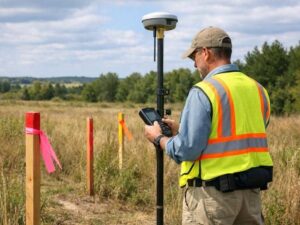
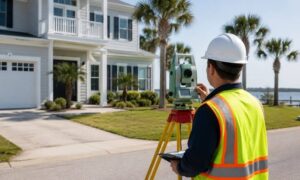
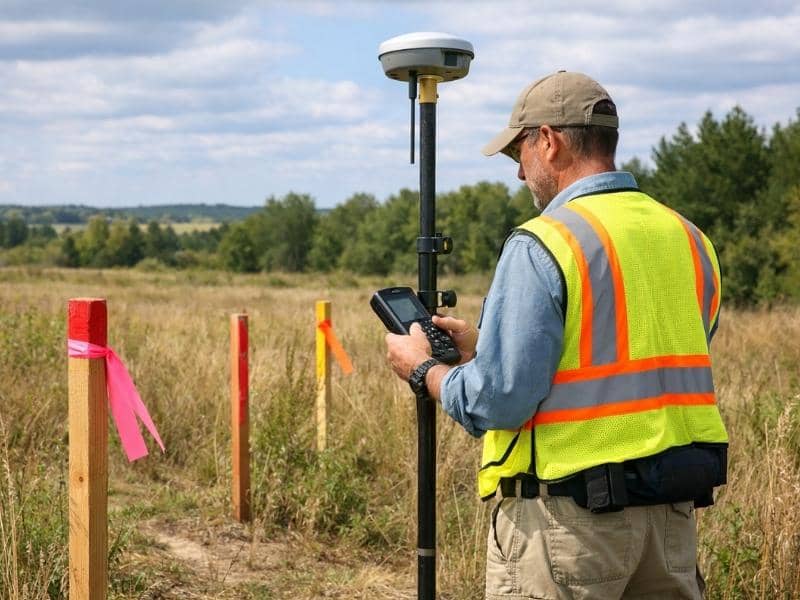
This is the part most people picture. The crew uses several tools. A total station measures angles and distances to within 2 to 3 millimeters at ranges up to 1,500 feet. Survey-grade GPS receivers are used for larger areas and can reach 5mm accuracy across several miles. For bigger or more complex sites, drones and LiDAR scanners capture data from the air in a fraction of the time it would take on foot.
One thing worth knowing: the instruments confirm what the legal records say should be there. When measurements and deed records don’t match, the surveyor uses boundary law to figure out the right answer. That’s a judgment call, not just a calculation.
Stage 4: Office Work and Drawing
Back at the office, the surveyor processes all the field data. They check that the boundary measurements form a consistent, closed shape. They sort out any differences between what was measured and what the deed says. Then they draft the survey drawing using CAD software. The drawing shows property lines, dimensions, structures, easements, and encroachments, depending on what type of survey was ordered.
Stage 5: Signing and Sealing
The PSM reviews the completed survey, signs it, and stamps it with their professional seal. That seal certifies that the survey was done under their direct supervision and meets Florida law. Without a valid PSM signature and seal, a survey cannot be used to close a real estate deal, get title insurance, pull a permit, or settle a property dispute in court.
Why This Matters More in Jacksonville
Jacksonville is one of the fastest-growing cities in the United States. According to ESRI projections, it is expanding at about twice the national average. That means new subdivisions, commercial buildings, road projects, and redevelopment of older parcels are all happening at the same time across Duval County.
Older neighborhoods like Springfield, Riverside, and Avondale have deeds written decades ago. Some describe boundaries using landmarks that no longer exist. Newer developments push property lines right up against wetlands, flood zones, and utility corridors. Small measurement errors in those situations can lead to big legal problems.
The U.S. Bureau of Labor Statistics reported a national median wage of $72,740 for surveyors as of May 2024. Employment is projected to grow 4 percent from 2024 to 2034, with around 3,900 job openings expected each year. That steady demand exists because no app or online map can replace the work. Only a licensed PSM produces a legally binding survey.