
If you live in Fort Myers, you probably know how expensive flood insurance can be. What many homeowners don’t realize is that their property might not even belong in the flood zone FEMA has mapped. That’s where a property survey comes in. It’s the first and most important step in proving your home’s true elevation and possibly saving thousands of dollars a year in insurance premiums.
Flood zones in Lee County have shifted after Hurricane Ian, and new FEMA maps are being reviewed all the time. While these maps help with safety planning, they are not perfect. A survey can reveal the actual ground levels and give you the evidence you need to challenge FEMA’s designation through a process called a Letter of Map Amendment (LOMA). Let’s walk through how this works, and why ordering a survey is the smartest move you can make if you want to fight back against high flood insurance costs.
Why Flood Zone Challenges Matter
Homeowners know floods are a serious risk, but the problem is that FEMA’s maps often paint with a wide brush. Sometimes entire neighborhoods are placed in a flood zone even when certain properties sit on higher ground. Unfortunately, lenders use these maps to decide if flood insurance is mandatory. That means you could be paying premiums even though your home is safe above the base flood elevation.
A property survey is the only way to prove your actual ground level. Once you have it, you can request FEMA to review your case. If they agree, your home could be removed from the flood zone, and your lender may no longer require flood insurance. In Fort Myers, where insurance costs can rival mortgage payments, this is a game changer.
Step 1: Check Your Current Zone
Before you order a survey, find out where FEMA currently places your property. Lee County offers a “Find My Flood Zone” tool online that shows your parcel on the latest flood maps. Print a copy or save it for your records. This is the baseline you’ll be working to challenge.
Step 2: Order a Property Survey with Elevation Data

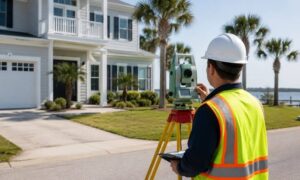
Next, contact a licensed surveyor. Make sure you ask for both a property survey and an Elevation Certificate (EC). The survey will confirm your lot boundaries and ground levels, while the Elevation Certificate provides the critical numbers FEMA needs to see—things like the lowest adjacent grade (LAG) and the finished floor elevation of your home.
Without these documents, FEMA won’t even consider your request. With them, you now have the precise information to show whether your house actually sits higher than the base flood elevation.
Step 3: Decide Between a LOMA or LOMR-F
Not every flood zone challenge is the same. The path you take depends on your situation:
- LOMA (Letter of Map Amendment): Used when your home was built on natural ground above the flood level.
- LOMR-F (Letter of Map Revision Based on Fill): Used if your lot was raised with fill dirt to lift it above the flood level.
Your property survey and Elevation Certificate will guide this choice. A good surveyor can help explain which option fits your property.
Step 4: Submit Your Application
Once you know which path to take, it’s time to file with FEMA. Most homeowners use the MT-EZ form for a single lot LOMA. If you need a LOMR-F or have multiple parcels involved, you’ll use the MT-1 form. Along with the forms, include your property survey, Elevation Certificate, and the FIRMette you printed earlier.
The fastest way to submit is through FEMA’s Online LOMC system. This portal lets you track the status of your application and ensures nothing gets lost in the mail. Typical processing times are about 60 days for a LOMA and 90 days for a LOMR-F.
Step 5: Keep Your Lender and Insurer in the Loop
Don’t wait until FEMA sends its final determination to talk to your lender and insurance company. Let them know you’ve submitted an application and provide the case number. Some insurers may even start reviewing your policy ahead of time, especially if the survey data looks strong. When FEMA issues the official Determination Document, give it to your lender right away. This is the paperwork they need to lift the mandatory flood insurance requirement.
Step 6: Save Everything
When FEMA approves your request, keep all the documentation safe. That means your property survey, Elevation Certificate, FIRMette, and FEMA’s Determination Document. Why? Because these papers will help again during resale, refinancing, or future map updates. Buyers and banks love having clear records, and you’ll avoid repeating the process later.
Local Perspective: Why Timing Matters
Homeowners should pay close attention right now. FEMA continues to update coastal flood maps after Hurricane Ian, and more changes are expected in the coming years. If your property is on the edge of a flood zone, challenging it sooner rather than later can lock in savings before new maps complicate the picture.
At the same time, the city is seeing rapid development, with new fill, new drainage systems, and changes in topography. Property surveys give you the most up-to-date proof of your lot’s elevation, which is essential in a shifting landscape.
The Bottom Line
Challenging your flood zone isn’t a simple formality—it’s a process that begins with a solid property survey. That survey provides the evidence FEMA requires to reconsider your home’s placement on the flood map. With insurance costs climbing higher each year, this step can make a major difference in your monthly budget.
If you believe your home sits higher than FEMA’s maps suggest, don’t wait. Order a survey, gather your documents, and submit your case. You might discover that a relatively small investment in professional surveying leads to thousands of dollars in savings and the peace of mind that your property is correctly classified.