Florida continues to invest in statewide LiDAR and shared mapping systems. At first glance, that sounds like great news. Better public maps should mean better planning, right? Yes — but only to a point. If you own land, plan to build, or want to develop property, you need to understand what this shift really means. While statewide mapping improves big-picture data, it does not replace drone land surveying for real projects. In fact, the difference between public mapping and site-specific surveying could save — or cost — you thousands of dollars.
What Florida Is Actually Doing
Florida has expanded efforts to coordinate LiDAR mapping across counties. LiDAR uses laser pulses from aircraft to measure the ground surface. As a result, the state can build large-scale elevation models for flood studies, transportation planning, and emergency response.
This helps planners see patterns across entire regions. For example, officials can study drainage basins, coastal erosion trends, and roadway corridors more easily.
However, that data serves regional planning — not individual property decisions.
And that’s where many people get confused.
Public Mapping Is Broad — Your Project Is Specific
Statewide LiDAR covers huge areas at once. Therefore, it gives a consistent baseline across counties. But your property sits on a specific lot, with specific slopes, soil, and drainage patterns.
Public mapping often:
- Updates on multi-year cycles
- Smooths small elevation details
- Misses recent grading or storm damage
- Lacks parcel-level certification
In coastal cities like Pensacola, small elevation differences matter. A few inches can change how water moves across a lot. Additionally, fill material, tree removal, or nearby construction can alter surface conditions quickly.
That’s why drone land surveying still plays a critical role.
Why Drone Land Surveying Still Matters
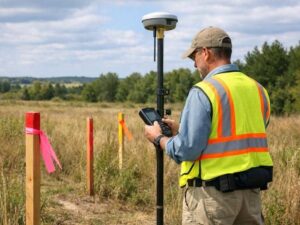
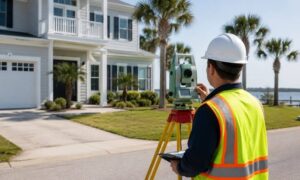
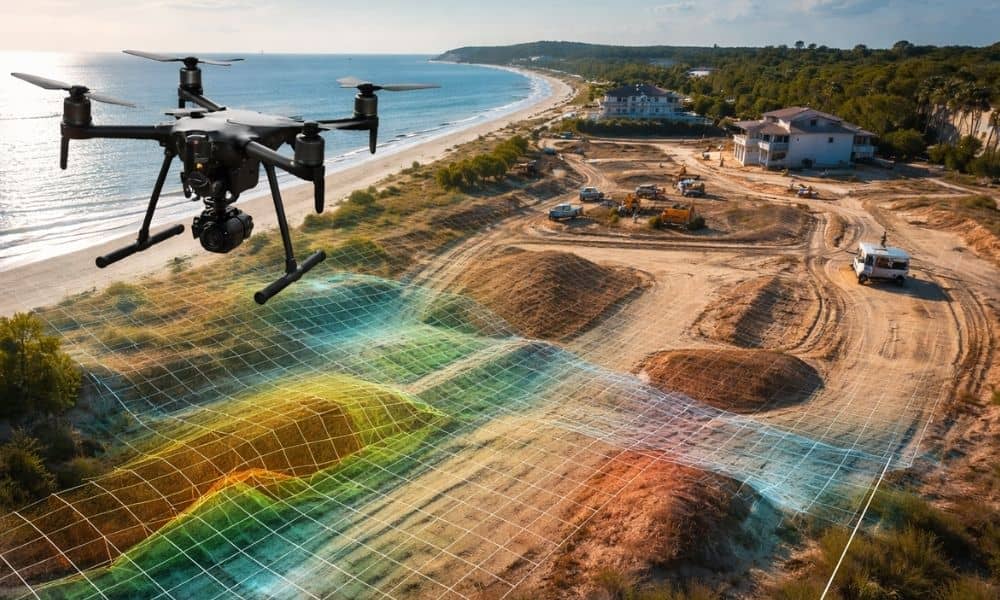
When a licensed surveyor performs drone land surveying, the work focuses on your exact property. The surveyor flies the site, sets control points, verifies elevations, and processes high-resolution data specific to your lot.
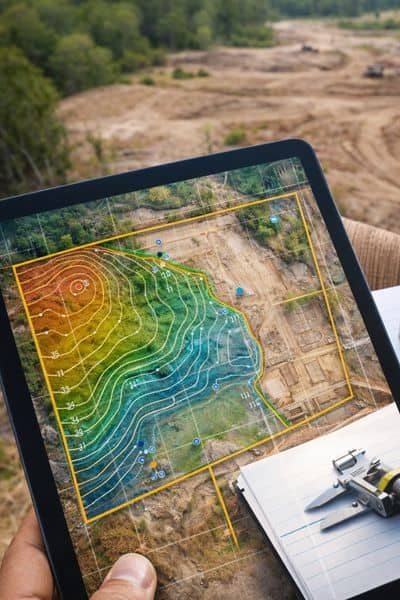
It’s more than just flying a drone overhead. The real value comes from how that data gets handled afterward. Through advanced drone mapping services, those aerial images turn into clear surface models that show how your land truly slopes, drains, and behaves.
As a result, you receive accurate topographic detail, reliable elevation data, and a clear understanding of site conditions before construction begins. Engineers can design grading correctly. Contractors can plan earthwork with fewer surprises. Permitting offices can review documentation with confidence.
Unlike public datasets, a professional survey ties the information directly to your parcel boundaries and legal description. Therefore, engineers and contractors can move forward knowing the numbers reflect what’s actually on the ground — not just a regional estimate.
The Risk of Relying Only on Public Data
At first, using free mapping tools seems tempting. Many property owners search online maps and assume the data tells the whole story.
However, public mapping does not:
- Certify boundary lines
- Confirm buildable pads
- Support grading permits
- Resolve drainage disputes
- Stand up in legal cases
Imagine this: you plan a new home on a vacant lot. The public map shows mild slope. However, a detailed drone land surveying project reveals low pockets that hold stormwater. If you skip that step, you might place your foundation in the wrong location.
Later, fixing that mistake could mean redesign fees, regrading costs, and construction delays.
In other words, early accuracy prevents expensive corrections.
Pensacola’s Unique Conditions
Pensacola brings added challenges. The city sits near the coast. Heavy rains move quickly across sandy soil. Furthermore, storms reshape land faster than many people realize.
Because of that, surface elevations shift. Drainage patterns change. Even nearby development can redirect water toward your property.
Statewide LiDAR may show general coastal trends. Yet it cannot capture last month’s grading work on your neighbor’s lot. It cannot detect subtle slope differences that affect driveway design or slab height.
Drone land surveying, on the other hand, captures current, site-specific conditions. That makes a major difference during design.
When Public Data Helps — and When It Doesn’t
To be fair, centralized mapping has value.
For example, if you explore land for a future subdivision, statewide LiDAR gives you a quick overview. You can review slopes, wetlands patterns, and nearby features before spending money.
Likewise, regional planners benefit from uniform data. Large infrastructure projects move faster when everyone works from the same baseline.
However, once you move from “idea stage” to “real project,” you need precise data.
You need drone land surveying if you plan to:
- Submit engineered construction drawings
- Design drainage systems
- Calculate cut-and-fill volumes
- Develop a subdivision
- Build near wetlands or coastal areas
- Address neighbor drainage complaints
At that stage, general mapping no longer works.
Drone Land Surveying Protects Your Investment
Think of public LiDAR as a wide-angle photo. It shows the landscape from far away. That helps with planning at scale.
Drone land surveying acts like a close-up lens. It reveals the fine detail that protects your investment.
Because surveyors tie drone data to ground control points, the information connects to real-world coordinates. Engineers rely on that accuracy. Contractors trust it when placing foundations. Lenders and regulators accept it for documentation.
Most importantly, you reduce surprises.
Construction rarely fails because of large, obvious problems. Instead, it fails due to small details that no one measured early.
Accurate site data solves that problem.
Florida’s Mapping Shift Is Positive — But It’s Not a Replacement
Florida’s effort to centralize mapping shows progress. Better regional data improves emergency response and planning. It also creates consistency across counties.
Still, it does not eliminate the need for licensed professionals. Public data cannot replace certified deliverables tied to a specific parcel.
In Pensacola, where elevation and drainage directly impact property value, relying on generalized maps carries risk.
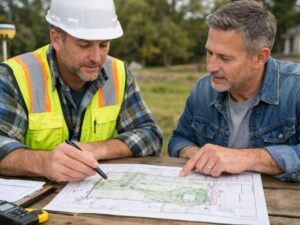
Instead, smart property owners use both tools wisely. They start with public mapping to understand the bigger picture. Then, before moving forward with construction or development, they sit down with a local survey team to review the actual site conditions. That’s where experienced firms like Pensacola Land Surveying step in — not to replace state data, but to refine it with property-specific drone land surveying that reflects what’s happening on the ground today.
That combination — broad data plus local verification — gives projects a much stronger foundation from the start.
The Bottom Line for Property Owners
Florida may centralize mapping data. However, your property still demands site-specific accuracy.
If you plan to build, develop, or improve land, drone land surveying gives you clarity before construction begins. It ensures engineers design correctly. It reduces change orders. It protects your timeline and your budget.
Public mapping gives you a broad picture.
Drone land surveying gives you certainty.
And when you invest in property along the Gulf Coast, certainty makes all the difference.