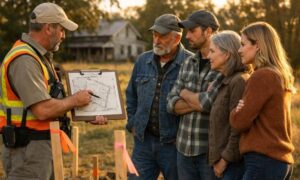
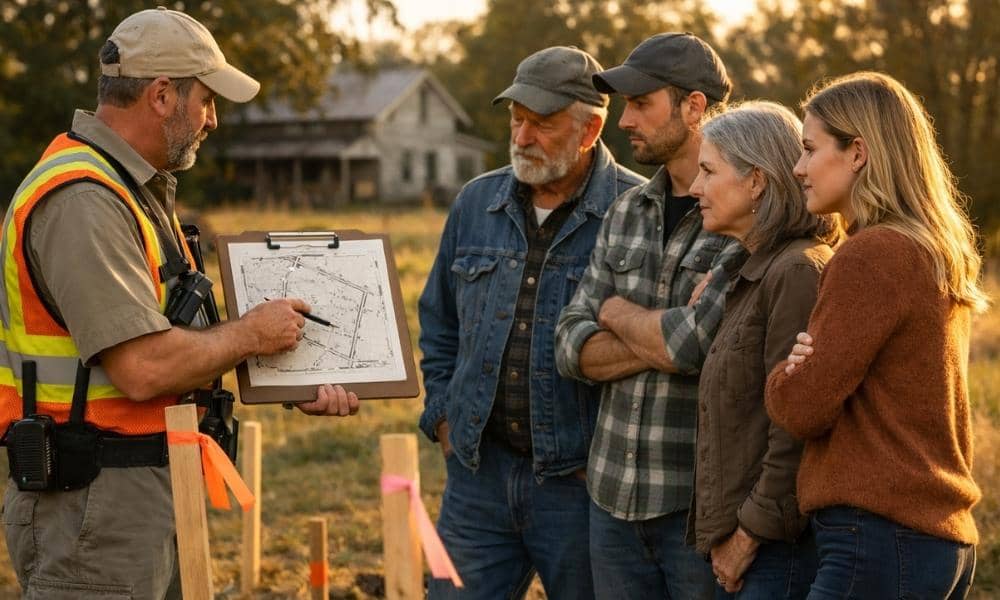
Family land carries history. It also carries risk. A metes and bounds survey is often the only way to find that risk before a property changes hands. Many parcels here have been passed down for generations. The legal descriptions tied to them were written long ago. Before any deed is signed, gifted, or settled through an estate, those descriptions need a close look.
Why Older Family Properties Often Still Use Metes and Bounds Descriptions
Florida has a long history of family-held land. Many older parcels still use metes and bounds descriptions instead of platted lot numbers.
These descriptions define land using directions, distances, and reference points. A typical one might say something like “beginning at an iron pin, thence north 45 degrees east 200 feet to a cedar tree.” That made sense when it was written. It may not make sense now.
Common issues include:
- Old deeds that point to landmarks no longer on the property
- Distance data that does not match modern GPS readings
- Descriptions written before accurate survey tools existed
- Language that assumed the reader knew the local area at a certain point in time
When land has passed through many hands or sat untouched for years, these gaps often go unnoticed. That changes the moment someone tries to sell, divide, or transfer it.
Inherited Land Can Reveal Hidden Description Conflicts
Inheriting land feels simple until the paperwork begins. Families often find that what they believe about the property does not match what the deed says.
This happens for a few reasons. Land may have been used one way for decades while the legal description says something different. A relative may have built a fence or used part of the land based on a verbal agreement, not a recorded survey. When that person passes away, those informal lines become a problem.
What surveyors often find on inherited land:
- Deed descriptions that overlap with a neighbor’s parcel
- Gaps between what the family uses and what they legally own
- Conflicts between the recorded description and the land’s actual shape
- Claims from nearby landowners that were never settled
A metes and bounds survey maps out what the legal description says and compares it to current conditions. That comparison often brings old conflicts to the surface.
Dividing Family Property Requires More Than a Verbal Agreement
Heirs often divide inherited land among themselves. One person takes the front. Another takes the back. They shake hands and move on.
The problem is that a handshake does not create a legal description. Without a recorded survey, each piece of land sits in a gray area. Future buyers, lenders, and title companies will not accept informal splits as proof of ownership.
A metes and bounds survey creates a legal description for each new parcel. That description can be recorded with Bay County and attached to a deed. Without that step, the split only exists in the family’s memory, not in the public record.
Why this matters for developers:
- Lenders need clear legal descriptions before they approve financing
- Title insurance cannot be issued on land with unclear boundaries
- Future transfers get complicated if the original split was never recorded
- A poorly described parcel can lower the value of land you already own nearby
Cutting this step to save time usually costs more down the road.
How Metes and Bounds Surveys Help Preserve Marketable Title
Marketable title means a buyer can take ownership without worry about a future challenge. For long-held family land, that is harder to prove when the legal description is old or unclear.
Attorneys and title professionals look closely at deed descriptions during a sale. If the description has gaps, overlaps, or points to landmarks that are gone, the deal can slow down or fall apart.
A metes and bounds survey helps by:
- Checking whether the recorded description matches the land being sold
- Finding boundary problems before they show up at closing
- Giving title companies updated records they can rely on
- Cutting delays in probate sales where several parties have a stake
Probate sales especially benefit from early survey work. When an estate is being wrapped up, delays cost money and create tension between heirs. A current survey on file helps move things along.
Preparing Family Land for Future Generations
Some families are not selling. They plan to keep the land and pass it on. A metes and bounds survey still makes sense here.
Old descriptions get harder to use over time. Monuments break down. Landmarks disappear. The people who knew what the description meant are no longer around to explain it. Each generation that inherits unclear records also inherits the problem.
Steps that protect long-term value:
- Order a survey before any transfer, even within the family
- Update the legal description if it points to missing monuments
- Record the updated description with the county so it is part of the public record
- Keep a copy of the survey with your estate planning documents
This protects more than the land. It protects the relationships between heirs by removing the confusion that leads to disputes.
Before You Sign Anything, Know What You Own
Family land holds real value. Keeping that value when ownership changes takes more than a signed deed. Metes and bounds surveys give you the records needed to confirm old descriptions, clear up hidden conflicts, and support clean transfers through inheritance, division, or sale. The sooner that work is done, the smoother the process goes for everyone.
Frequently Asked Questions
What are metes and bounds surveys?
Metes and bounds surveys identify property boundaries using directions, distances, monuments, and legal descriptions found in deeds and other land records.
Why are metes and bounds surveys important for inherited property?
Inherited land often has older legal descriptions that are hard to read. A survey helps confirm the property’s boundaries before ownership is transferred.
Can a metes and bounds survey help divide family-owned land?
Yes. When heirs split inherited property, a metes and bounds survey can create accurate legal descriptions for each new parcel.
How old can a metes and bounds description be?
Some go back decades or even generations. Older descriptions may point to landmarks or monuments that no longer exist, making a professional review important.
Do metes and bounds surveys help during probate or estate settlements?
They can help clarify property descriptions and reduce uncertainty when land is being transferred through probate, estate administration, or family succession planning.