
When a Port St. Lucie homeowner discovered that land she owned had been sold without her knowledge, the story spread fast. Neighbors talked about it. Social posts lit up. Local news covered the legal fight. Most people asked the same question: How could this happen? The answer points to one overlooked step—getting a boundary survey early. Within the first moments of owning property, clear boundaries protect ownership, prevent confusion, and stop costly surprises before they start.
A local story that hit close to home
The case shocked many because it felt personal. This was not a faraway scam or a complicated corporate deal. It involved a regular homeowner in Port St. Lucie who believed her land was secure. However, gaps in records and unclear parcel details opened the door to fraud. As the story circulated, people realized something important: land ownership depends on clarity, not assumptions.
Meanwhile, Port St. Lucie continues to grow. New buyers arrive, long-held parcels change hands, and vacant lots gain value. As a result, old records get tested. When those records do not line up, problems surface fast.
How land can change hands without the owner knowing
At first, the idea sounds impossible. After all, property records exist for a reason. Yet problems begin when descriptions stay vague or outdated. In many neighborhoods, parcels were created decades ago. Over time, surveys age, markers disappear, and records get copied again and again.
Because of that, bad actors look for gaps. They rely on unclear boundaries and incomplete verification. Then they file paperwork that appears valid at a glance. Without clear proof tied to the land itself, owners may not spot the issue until damage occurs.
Even honest mistakes can cause trouble. A small mismatch between a deed and a plat can snowball. Eventually, that mismatch can trigger disputes, delays, or worse.
Why boundary confusion increases risk
Clear ownership depends on clear boundaries. When boundaries stay uncertain, confusion spreads across records, maps, and filings. That confusion creates risk. For example, two documents may describe the same land in different ways. If no one checks the ground, errors remain hidden.
A boundary survey closes that gap. It connects the legal description to the physical land. It confirms what belongs to whom and where it sits. Without that link, paperwork alone cannot protect ownership.
What a boundary survey actually verifies
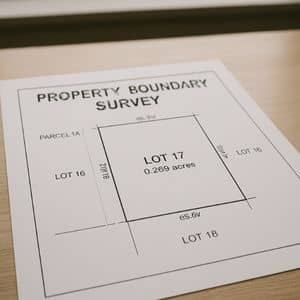
Many homeowners think a survey only draws lines on paper. In reality, it does much more. A boundary survey verifies the exact parcel tied to the deed. It confirms corner locations, checks measurements, and compares records for consistency.
More importantly, it creates defensible documentation. If questions arise later, that documentation shows how the property was identified and measured. Because it ties records to reality, it strengthens ownership claims and reduces uncertainty.
This matters most before trouble starts. Once disputes begin, options shrink. Early verification keeps control in the owner’s hands.
Why properties face higher exposure
Florida’s rapid growth adds pressure to land records. Cities expand. Parcels split. Vacant land turns valuable. Meanwhile, many properties still rely on old surveys created for a different landscape.
Port St. Lucie reflects this trend. Some neighborhoods developed quickly, while others changed slowly. Inherited land adds another layer, since families may rely on memory instead of updated documentation. Over time, uncertainty builds.
Therefore, properties with outdated records face higher exposure. Without clear boundaries, ownership can feel secure until someone challenges it.
When homeowners should verify boundaries
People often wait for a trigger. They check boundaries only when selling or when a problem appears. However, smart owners act earlier.
For instance, verifying boundaries makes sense before selling vacant land. It also helps before refinancing or changing ownership. Additionally, owners who have not reviewed records in decades benefit from an update.
Even when nothing feels wrong, peace of mind matters. A boundary survey replaces guesswork with clarity. That clarity protects both value and rights.
Why this story resonated so strongly
The Port St. Lucie case spread because it exposed a blind spot. Many homeowners assume records alone protect them. When that belief breaks, fear follows. People imagine losing land they worked hard to own.
Social sharing amplified the lesson. Each post reminded readers that property remains one of life’s biggest investments. Losing control over it feels unthinkable. Yet the case showed how easily gaps can appear.
Because the story felt local and real, it sparked action. People started asking how to protect themselves.
Prevention beats recovery
Legal battles cost time and money. Stress adds up. Even when owners win, the process drains energy. Prevention avoids all of that.
A boundary survey acts like ownership insurance. It does not stop every risk, but it removes major vulnerabilities. By confirming boundaries early, owners reduce the chance of disputes, fraud, and confusion.
Think of it this way: clarity today prevents chaos tomorrow. Clear lines keep records honest and ownership strong.
The takeaway for Lucie homeowners
The viral dispute delivered a simple message. Property security depends on verification, not trust alone. While no one expects fraud, preparation matters.
A boundary survey gives that preparation. It turns assumptions into facts. It strengthens records. Most of all, it protects what matters.
As Port St. Lucie grows, ownership clarity becomes even more important. Homeowners who act early stay ahead of risk. In the end, knowing exactly where your property begins and ends brings confidence that lasts.