How To Find Your Property On FEMA’s Flood Insurance Rate Maps

What are FEMA flood maps?
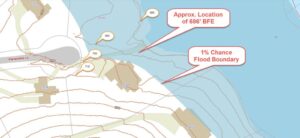
FEMA’s Flood Insurance Rate Maps (FIRMs) or just Flood Maps are provided after a flood risk assessment has been completed or updated for a community.  This study is known as a Flood Insurance Study.  The FIRM gives you the Base Flood Elevations (BFEs) and insurance risk zones in addition to floodplain boundaries.  The FIRM may also show a delineation of the regulatory floodway.

Once the “insurance risk zone”  (commonly referred to as the flood zone) is determined, actuarial rates, based on these risk zones, are then applied for newly constructed, substantially approved, and substantially damaged buildings.  FEMA uses these rates to determine the insurance rate you will pay for flood insurance

FEMA’s Digital Flood Maps

FEMA discontinued the production and distribution of paper flood maps in 2009 as part of its Digital Vision Initiative. This affected all the Flood Maps, boundary information, and study reports. However, clients can still view the products for free through their website or buy them in digital format.

To view these flood maps online, go to FEMA’s Map Service Center and key in your address (hi-lited area shown here) search for your home.  This will prompt you to then select the map that covers your area.  The Flood Maps are somewhat cumbersome to use online. It is best to go through the tutorial on the bottom right of the address search page for an easier and more effective use of the GIS map.


author avatar
Surveyor

More Posts

Homeowner reviewing an elevation certificate and property documents at a table before ordering a new survey
flood damage
Surveyor

Check Your Elevation Certificate Before Ordering New

You get a call from your lender or insurance agent. They tell you that you need an elevation certificate. At first, it sounds simple, so your first thought is to go ahead and order one. However, that first step can cost you more than it should. In Cape Coral, many

Read More »
Homeowner reviewing a plat of survey on a table while planning a driveway layout near a residential property
land surveying
Surveyor

How to Read a Plat of Survey Before Adding a Driveway

You plan to add a driveway or widen the one you already have. At first, it feels like a simple upgrade. You picture easier parking, smoother access, and better use of your space. However, once you start looking into permits, things can quickly become confusing. The city may ask for

Read More »
Surveyor collecting topographic survey data on a residential property before construction
land surveying
Surveyor

Why Permits Get Delayed Without a Topographic Survey

If you’re planning to build or improve your property, you probably expect some delays. That’s normal. However, many homeowners run into a frustrating problem they didn’t see coming. Their plans get sent back by the city, even though everything looks ready. In many cases, the issue isn’t the design. Instead,

Read More »
Comparison of an online parcel map and a real property boundary showing differences that a cadastral surveyor would verify
land surveyor
Surveyor

What Parcel Maps Don’t Show: A Cadastral Surveyor Explains

Recent flood warnings across South Florida caught a lot of attention. In Pembroke Pines, many homeowners started checking their property lines online. It felt like the right thing to do. After all, when water moves through a neighborhood, people naturally want to understand their land better. So, they opened parcel

Read More »
Aerial view of homes showing uneven flooding, highlighting how a topographic survey helps reveal elevation differences before building
land surveying
Surveyor

Topographic Survey: What Flooding Reveals About Your Land

Heavy rain hit Miami-Dade again, and it didn’t take long for problems to show. Streets filled up, yards stayed wet, and some homes saw water move closer than expected. Yet just a few houses away, others stayed dry. So what caused the difference? At first glance, most lots in Hialeah

Read More »
Comparison of a clean lidar mapping model and a residential property with visible water pooling and drainage issues
land surveying
Surveyor

Why LiDAR Mapping Looks Accurate but Has Elevation Issues

You get your lidar mapping results, and everything looks sharp. The lines are clean. The details are clear. At first, it feels like you have the perfect picture of your land—just like you would expect when reviewing your property survey results. However, weeks later, something feels off. Water starts pooling

Read More »